
Kitesurfing Lessons: How Long to Learn, Wind and What It Costs
Reviewed by Jonathan Boettger, founder · Updated Nov 24, 2026
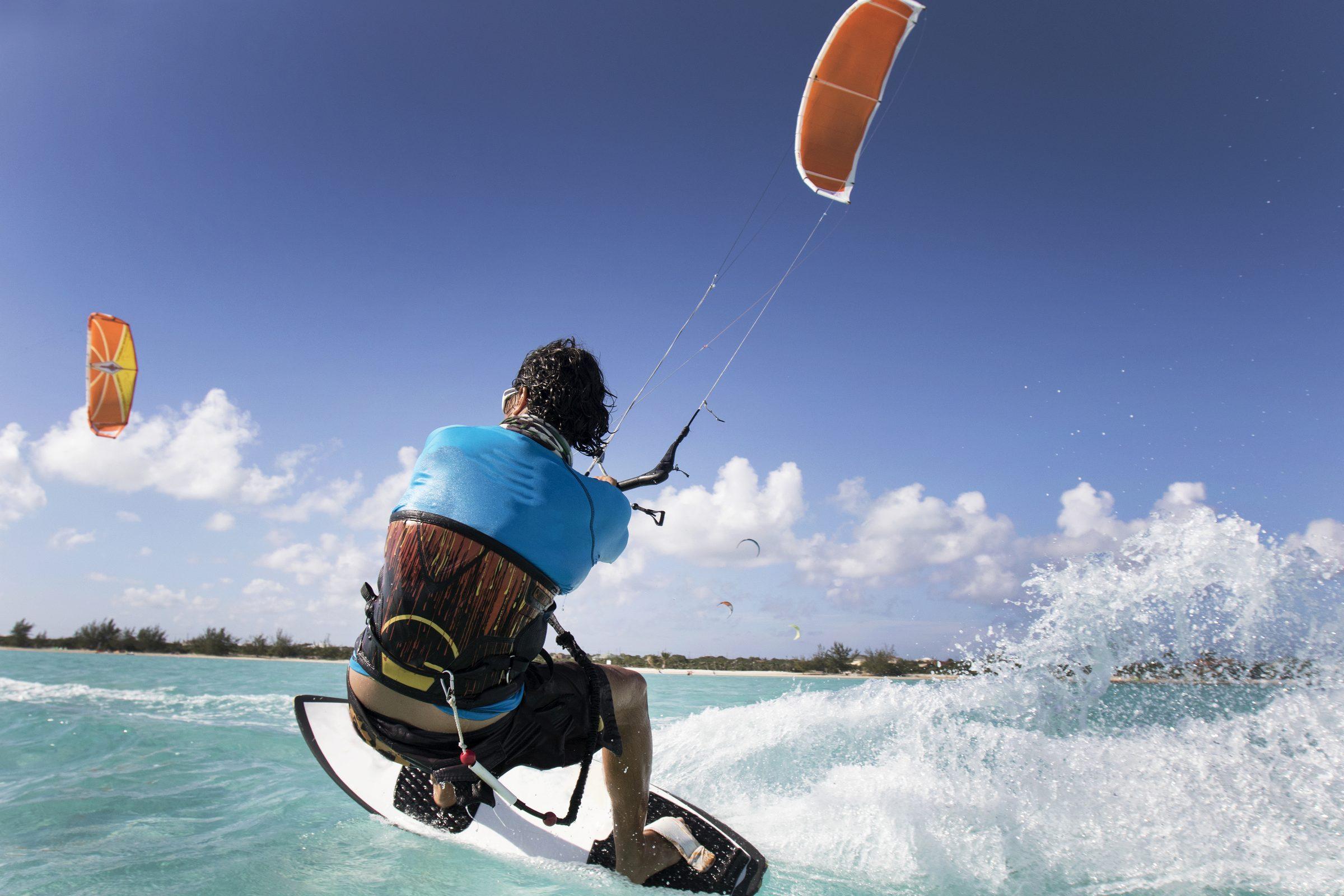
Kitesurfing starts with lessons, not a rental. You learn to fly a trainer kite on the beach, then drag through the water with a full kite, and only then add the board. Most people need several lessons before they ride.
Board and sail with no kite? See the Windsurfing.
What kitesurfing is like
You stand on a small board and a large kite pulls you across the water. The kite flies on long lines attached to a harness around your waist, so your body, not your arms, takes most of the pull. You steer the kite with a control bar to make power, and steer the board with your feet.
Once you're up and riding, it feels fast and light, close to flying across the surface. Getting there takes lessons: most of the early hours are spent learning to control the kite, not riding the board.
How the first lessons progress
Kitesurfing is lesson-first. It is not a same-day rental like a paddleboard. A typical beginner course runs in three steps:
- On the beach: wind, setup, safety systems and flying a kite.
- Body dragging: in the water without a board, letting the kite pull you, getting your board back and relaunching the kite.
- Water start and first rides: getting on the board and riding short distances.
Is it hard? Kite control is the hard part. Once you can fly the kite without thinking about it, the board comes quickly.
Do you need a lesson? Yes. Kites generate a lot of power, and the safety release systems need to be taught in person.
How long does it take? A typical beginner course is 8 to 12 hours of instruction spread over several days (iksurfmag.com). Wind doesn't always show up, so leave spare days if you're learning on a trip.
Who can learn (and do you need to swim?)
Most reasonably fit adults and teens can learn. Strength matters less than you might think, because the harness carries the load. What matters more is staying calm in the water and following the instructor's wind and safety calls.
Do you need to swim? Yes, for real lessons. You will fall in, drag through the water and sometimes swim back to your board, so schools expect you to be comfortable swimming in open water. You'll wear a buoyancy or impact vest, but it doesn't replace being able to swim. If you can't swim yet, take swim lessons first.
Minimum age and weight rules vary by school, because a light rider can be lifted by a gust. Ask before you book, especially for kids.
How much wind you need, and where to learn
How much wind: kitesurfing needs at least about 12 knots, and most riders are comfortable in roughly 12 to 23 knots (windy.app). Too little and the kite won't fly; too much or too gusty and the session is called off. Schools avoid offshore wind (blowing from land out to sea) for beginners, because it can carry you away from shore. Expect some lessons to be rescheduled for wind.
Where: look for shallow, flat water with steady side-onshore wind and a wide beach. This page has schools in Florida and North Carolina (see By state), plus schools in California. In Hood River, Oregon, strong thermal winds blow nearly every day from May through September, and the water only warms to around 70°F by late July (iksurfmag.com).
When: wind and water temperature set each school's schedule, so ask which months it teaches.
Kitesurfing or windsurfing?
| Kitesurfing | Windsurfing | |
|---|---|---|
| What pulls you | A kite on long lines | A sail fixed to the board |
| First day | On the beach with a kite | On the water on a big, stable board |
| Getting to real riding | Usually faster, once kite control clicks | Often slower; harness and foot straps can take a long time |
| Gear to carry | Packs into a bag | Board and rig are bulky |
| Lessons | Required to start | Recommended |
Windsurfing has a gentler first day; kitesurfing usually gets you planing sooner once you can fly the kite (iksurfmag.com). See Windsurfing for that hub.
What to wear and bring
- School gear: most schools include the kite, board, harness and helmet. Ask what's included when you book.
- Wetsuit: wear one in cool water, and ask the school what thickness it recommends. In warm water, a rash guard and board shorts are enough.
- Impact or buoyancy vest: useful for beginners; ask if the school provides one.
- Sun: reef-safe sunscreen and a rash guard. Leave sunglasses and jewelry on shore unless they're strapped on.
- Bring: water, a snack, a towel and a dry change of clothes.
What it costs
Exact prices come from the operator, so ask when you book. Most schools sell lessons by the hour or as multi-hour packages, and a full beginner course takes several sessions.
What moves the price: private vs. shared lesson, hours in the package, whether a boat or jet ski is used, radio helmets, and gear included.
Where to find kitesurfing companies
Seeking Adrenaline has 49 kitesurfing companies in 8 states. They are in alphabetical order, and the number is how many companies we have there. Search a city or ZIP at the top of the page to see them.
- California (7)
- Florida (18)
- Hawaii (6)
- Massachusetts (1)
- Michigan (1)
- North Carolina (7)
- Oregon (5)
- Texas (4)
Related activities
Sources
- IKSURFMAG: how much are kitesurfing lessons iksurfmag.com
- IKSURFMAG: is kitesurfing harder than windsurfing iksurfmag.com
- Windy.app: complete guide to windsports windy.app
- IKSURFMAG: Hood River travel guide iksurfmag.com
About the Seeking Adrenaline team
Our guides are drafted with help from automated tools, then reviewed by the Seeking Adrenaline team.
